
Sump Pump Failure
Emergency response to sump pump failures before water causes structural damage.
Our Sump Pump Failure Process
Emergency Call
Call our 24/7 line — crew dispatched immediately.
60-Min Arrival
We arrive, assess, and brief you on the plan.
Mitigation
Stop damage from spreading — fast.
Full Restoration
Certified restoration to pre-loss condition.
Sump Pump Failure in Fairfield County, CT & Westchester County, NY
Sump pump failure during heavy rain is one of the most common Fairfield County and Westchester County basement-flood scenarios we respond to. A primary sump pump runs for years without problems, then fails — usually at the worst possible moment, during an overnight thunderstorm or spring snowmelt — and the homeowner wakes up to two to four inches of water across a finished basement. Without a battery backup pump as a second line of defense, even brief power outages combined with rain can produce the same result.
911 Storm responds to sump-pump-driven basement flooding 24/7 across our 67-city service area. We extract the standing water, dry the basement envelope to IICRC S500 targets, demolish unsalvageable materials, and bill your insurance carrier directly. If the cause was a sump pump failure (rather than acts of God), most policies cover the water mitigation scope under the standard water-damage coverage, with the sump-pump-failure endorsement covering the broader scenario including damaged contents.
Why sump pumps fail
Most sump pump failures fall into one of five buckets. Power outage during the storm (pump cannot run without power, and no battery backup was installed). Mechanical failure of an aging pump (typical lifespan 7-10 years; many basements still have the original builder-grade pump from when the house was new). Float switch sticking from sediment buildup in the sump pit. Discharge line frozen or clogged, blocking outflow. Pump capacity exceeded by extreme rainfall events (a 1/3 HP residential pump cannot keep up with extreme inflow during major storms).
Each failure mode is preventable with proper maintenance and the right system design. We have seen too many flooded basements where the failure point was a $200 fix (battery backup pump) deferred for years.
Our sump-pump-failure response
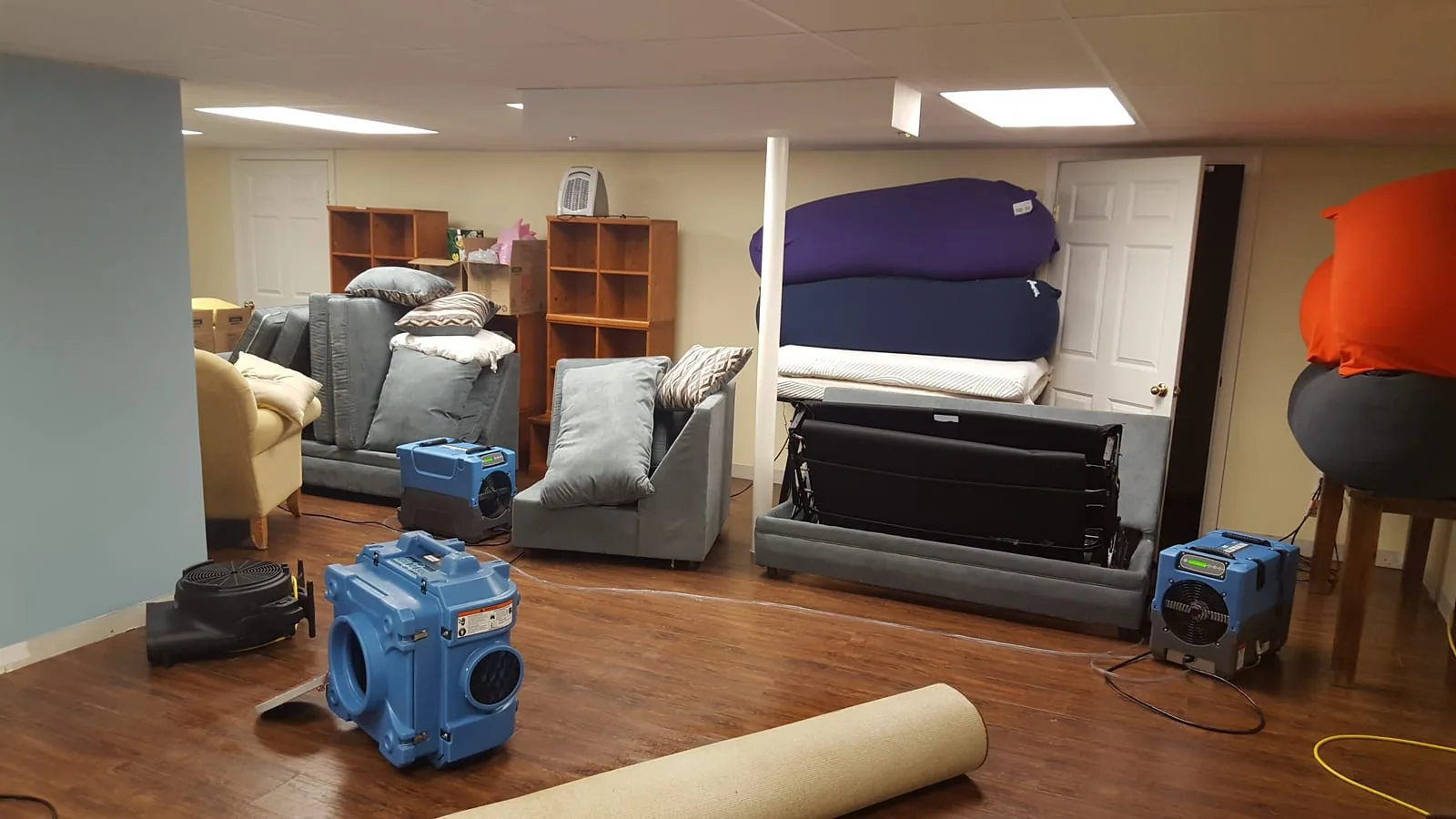
Arrival within 60 minutes. Standing water extracted via truck-mounted extractor — typical 800-1,200 square foot finished basement dewaters in 60-90 minutes after our arrival. Wet carpet pad removed (cannot be reliably dried). Drywall flood-cut at appropriate height. Saturated batt insulation removed. Framing dried in place with LGR dehumidifiers and air movers running 24/7 over 5-7 days. Daily moisture log to IICRC S500 standard.
If the failed sump pump was the cause and the basement is unfinished or utility-room only, scope is typically $3,000-$8,000 for mitigation. Finished basement with full demolition + drying + reconstruction usually runs $8,000-$25,000. Documentation of the failure (the dead pump preserved as evidence) supports the insurance claim — preserve the pump for the adjuster.
Preventing the next sump pump failure
Battery backup sump pump installation as a second line of defense ($300-$800 installed). Annual sump pump inspection and test cycle. Sump pit cleaning to prevent float switch sticking. Discharge line inspection and freeze protection (extension above the freeze line, insulation, or heat tape). Capacity upgrade to 1/2 HP pump for homes with heavy groundwater intrusion. As part of the rebuild phase after a sump-pump failure event, we install or coordinate installation of these preventive measures so the next storm doesn't produce the same outcome.
Related Water Damage Services
Sump Pump Failure Near You
Covered loss? We bill your insurance carrier directly — and our CT insurance claim guide walks the whole process. Estimate your scope with the cost calculator.
How Long Does Sump Pump Failure Take?
Every job is different, but here's a realistic timeline for most sump pump failure projects.
Emergency Call
0 minCall our 24/7 dispatch — crew assigned immediately.
On-Site Arrival
~60 minIICRC-certified crew arrives, assesses, and presents plan.
Water Extraction
Day 1 (1-4 hrs)Truck-mounted extractors remove standing water, 500+ GPM.
Structural Drying
Day 2-7Air movers + LGR dehumidifiers, daily moisture verification.
Clearance + Rebuild
Day 7-14+Thermally verified dryness, then drywall, flooring, finish.
Timelines vary with scope, insurance adjuster response, and hidden damage discovered during work. Your detailed timeline is given after the on-site assessment.
Common Questions
Sump Pump Failure FAQ
Will my homeowner insurance cover sump pump failure?
Depends on your endorsement. Standard homeowner policies generally exclude sump pump failure and sewer backup unless you have the water-backup or sump-pump endorsement (often combined). The endorsement is typically inexpensive ($50-$150 annual premium) and covers the resulting water damage. Without the endorsement, coverage often is denied. Check your declarations page now, not after the next failure.
Can a battery backup pump prevent this?
Battery backup sump pumps run when the primary loses power (storm outage being the most common scenario). They typically buy 6-12 hours of operation depending on inflow rate and battery capacity — enough to ride out most power outages. Combined with the primary pump, two layers of defense significantly reduce flood risk. Installation is $300-$800 typical, well worth the protection for finished basements.
How long does sump-pump-flood mitigation take?
Cat 1 (clean rainwater) basement flood from sump failure: 5-7 days drying including demolition of wet carpet pad and lower drywall. Plus 1-3 weeks reconstruction (new pad, drywall, paint, trim, carpet). Cat 2 if water sat 48+ hours before mitigation started: 7-10 days drying with antimicrobial. Total turnaround typically 3-5 weeks from event to restored.
Should I install a new sump pump as part of the rebuild?
Almost always yes. The failure that caused the flood usually indicates the pump is at end of life. Replacement during the rebuild phase costs less than separate dispatch later, and proper installation (correct pump size for your inflow, battery backup, freeze-protected discharge line) prevents the next event. We coordinate plumber installation as part of the rebuild scope where appropriate.
What if the power is out during the storm — can you still respond?
Yes. We operate on truck-mounted extractors and generators for power. Our crews respond during active storms and power outages — that's the period when sump failures cluster. The challenge during widespread outages is queue (many homes flooding simultaneously); calling early during the event puts you higher in the dispatch queue.
Damage Doesn't Wait — Neither Do We
60-minute response. Free estimate. We handle your insurance claim.
IICRC Certified • Licensed & Insured • All Major Insurance Carriers