
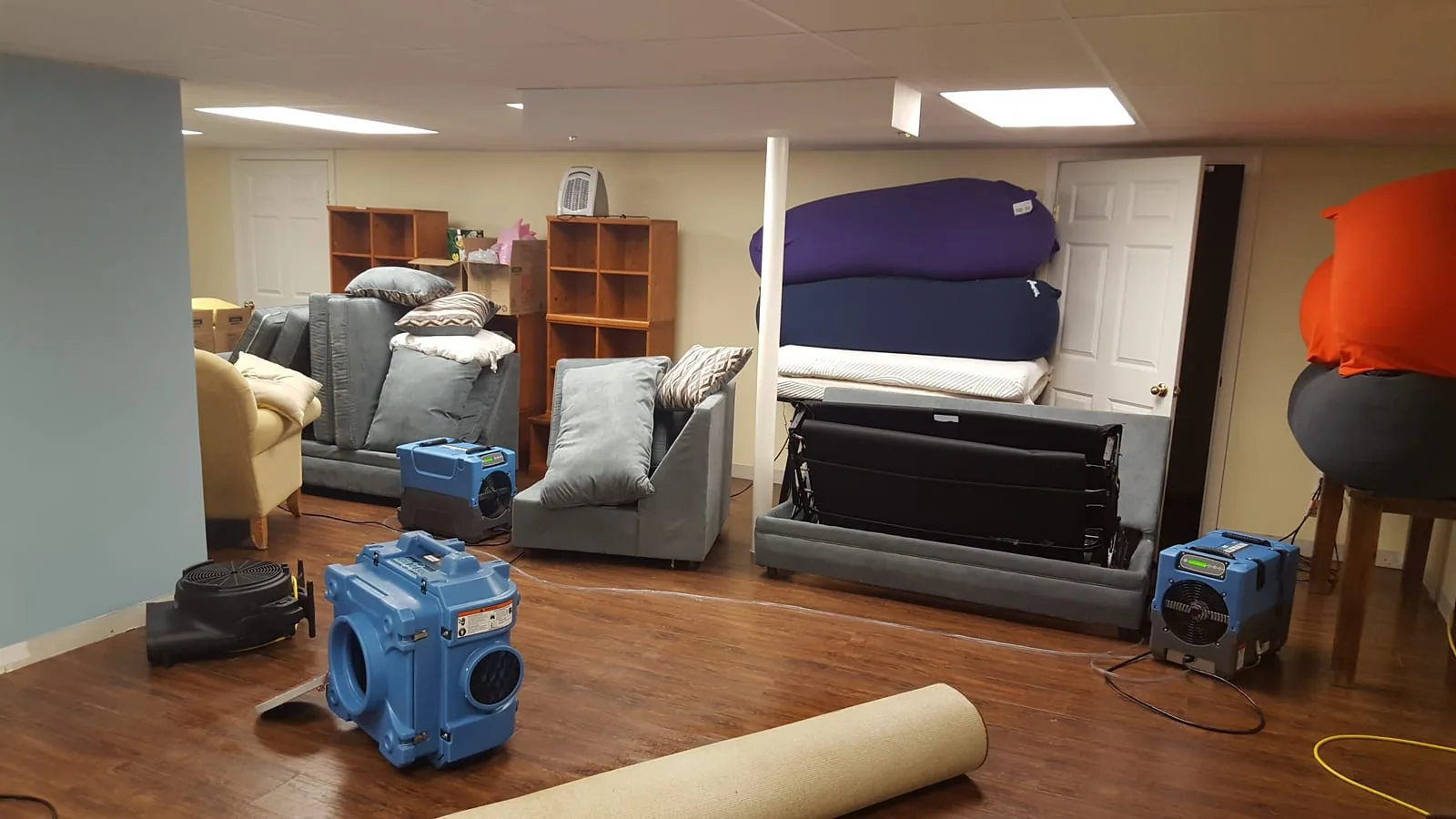
Before you do anything
The hour after you discover water damage shapes the entire claim. The mistakes homeowners most commonly make in that first hour are: (1) trying to fix the source themselves before documenting, (2) waiting for "the right time" to call the insurance carrier, (3) using a wet-vac and assuming that solved it, (4) doing nothing and "seeing how it looks tomorrow."
The right sequence is short: stop the water source (main shutoff, electricity if water is near outlets), photograph everything in its damaged state, call your insurance carrier to open a claim, call an IICRC-certified restoration contractor to start mitigation. All within the first 60 minutes. Mitigation cannot wait — Connecticut policies require you to mitigate damage promptly. Delay can void coverage on the worsened damage.
If water has been wet 48+ hours
Visible mold can begin growing on porous materials. This triggers IICRC S520 mold protocols and your policy's mold sublimit (typically $5K-$25K). Speed of mitigation = limiting mold exposure = staying within the water-damage coverage rather than burning the smaller mold sublimit. Learn what S520 requires →
What's covered vs what's not
The single biggest claim-killer is misunderstanding what the policy actually covers. Standard CT homeowner policies cover sudden-and-accidental water loss. They generally do NOT cover gradual leaks, rising surface water (flood), or anything described as deferred maintenance.
- Burst pipe (sudden water release)
- Frozen pipe burst from sudden cold
- Sudden appliance failure (washing machine hose, water heater)
- Roof leak from storm damage (sudden, identifiable storm event)
- Toilet overflow (sudden, not gradual)
- Ice dam interior water intrusion
- Wind-driven rain through damaged roof / window
- Sewer backup (with water-backup endorsement)
- Sump pump failure (with sump-pump endorsement)
- Mold resulting from a covered water loss (up to policy sublimit)
- Gradual leak — anything described as "has been leaking for months"
- Surface flood from rising groundwater or rivers (requires separate NFIP / flood policy)
- Maintenance-related water damage (failed seals, deferred repair)
- Sewer backup WITHOUT the water-backup endorsement
- Sump pump failure WITHOUT the sump-pump endorsement
- Mold from gradual moisture (chronic basement humidity, etc.)
- Mold above the policy sublimit
- Code-upgrade reconstruction beyond pre-loss condition (unless code-upgrade endorsement)
- Pre-existing water damage discovered during the loss
- Foundation cracks (typically not water-loss; structural)
"Usually" matters — your specific policy controls. Read your declarations page. The endorsements section is where coverage actually lives or dies (water-backup endorsement, sump-pump endorsement, code-upgrade endorsement, scheduled mold endorsement).
The 10-step claim process
Below is the actual sequence we walk Fairfield County homeowners through every week. Working it in this order produces the cleanest, fastest, most fully-paid claims.
- 1
Stop the source — but don't fix it yet
Shut the main valve, kill power to the affected area if water is near outlets, place buckets under active leaks. DO NOT attempt repair before the carrier inspects: any 'fix' before documentation can become a coverage argument. Photograph everything in its damaged state before mitigation begins. Connecticut courts and carriers both recognize the duty to mitigate, but mitigation ≠ repair.
- 2
Call your insurance carrier — file First Notice of Loss
Call the carrier's claims line directly. Have your policy number ready. They'll assign a claim number and an adjuster. Ask: (1) is this likely a covered loss? (2) what's my deductible? (3) what's the mold coverage limit? (4) do I need to wait for an adjuster before mitigation? Most CT carriers will tell you to mitigate immediately and document — waiting actually violates your duty under the policy.
- 3
Call a restoration contractor — start mitigation
IICRC-certified contractor, 24/7 line, can be on site within 60 minutes for most Fairfield County and Westchester emergencies. They'll start extraction and drying immediately, photograph everything, and document moisture readings at every test point. This documentation is what the carrier pays from. Mitigation cannot wait — every 24 hours of delay multiplies the damage and can trigger mold, which has its own coverage cap.
- 4
Document everything — before, during, after
Photo and video every damaged area before mitigation. Keep the receipts: emergency hotel costs if displaced (Additional Living Expense coverage), takeout food, cleaning supplies. Save the broken pipe, failed appliance, fallen tree — whatever caused the loss. The carrier may request to inspect it.
- 5
Adjuster inspection — be present, ask questions
Carrier sends an adjuster (often within 3-7 days for non-emergency losses, same-day for major events). Be present. Walk them through every affected area. Don't accept their first scope estimate as final — your contractor will provide their own Xactimate scope, and these should reconcile. Disagreements at this stage are common and normal.
- 6
Restoration contractor submits Xactimate scope
Within a few days of mitigation start, your contractor should submit a formal Xactimate scope to the carrier — the same software the adjuster uses. Line-item pricing, defensible, regional. This is the document the carrier issues payment from. Review it before submission and ask about any line items you don't understand.
- 7
Carrier approves scope (or pushes back)
Typical approval timeline: 3-7 days for clear sudden-and-accidental water losses. Longer if mold is involved (carrier may require third-party testing first). If the carrier pushes back on line items, ask your contractor to explain the justification — many disputes are resolved by attaching IICRC standard references (S500, S520) to the scope line items.
- 8
Mitigation finishes — clearance documentation
Once moisture targets are met, contractor produces clearance documentation: final moisture log, daily psychrometric readings, antimicrobial application records, photo documentation of completion. For mold work: third-party post-remediation verification (PRV) test results. Carrier reviews; closes mitigation phase of claim.
- 9
Reconstruction phase begins (if needed)
If the loss required demolition (saturated drywall, ruined flooring, damaged cabinets), reconstruction is the second phase. Often a separate contractor; sometimes the restoration company also handles rebuild. Carrier issues a second payment for this scope. Make sure the rebuild matches your pre-loss finish standard — Connecticut carriers (especially HNW like Chubb/PURE/AIG) recognize like-kind-and-quality requirements.
- 10
Final payment — verify deductible math
Total approved scope minus your deductible = carrier payment. Carrier pays the contractor directly (if direct billing was set up) or pays you and you pay the contractor. Verify the deductible was applied correctly — common error is double-application across mitigation + reconstruction. Keep all claim documentation for 3+ years; mold claims sometimes reopen.
Deductibles in Connecticut
Connecticut homeowner deductibles fall into three categories you'll encounter on any water damage claim:
Standard deductible
Typically $500 to $2,500 on standard market policies. Higher on HNW policies (often $5K-$25K to get premium down). Applies to most water claims (burst pipe, appliance failure, etc.).
Wind / Hurricane deductible (coastal CT)
In Fairfield, New Haven, and New London counties (CT's coastal counties), many policies have a separate hurricane deductible — typically 1-5% of dwelling coverage. On a $1M dwelling that's $10K-$50K, much higher than standard. Triggers when NWS officially declares a hurricane affecting CT. Standard nor'easters typically don't trigger hurricane deductibles — but coverage language varies.
Water-backup deductible (sewer/sump)
Sewer backup and sump-pump failure require the water-backup endorsement. The endorsement carries its own deductible (often $500-$1,000) and its own sublimit (often $5K-$25K). Check your declarations.
Mold coverage limits in Connecticut
Mold coverage was nationally sublimited after the 2001-2003 Texas mold litigation (the Ballard case). Connecticut homeowner policies carry mold sublimits — knowing yours is critical because mold scopes can exceed the standard water-loss budget very quickly.
Typical CT mold sublimits by carrier tier:
- • Standard market (State Farm, Allstate, Liberty Mutual): $5,000 to $10,000 default; up to $50K with paid endorsement.
- • Regional (Travelers, Hanover, Amica, Plymouth Rock): $10,000 to $25,000 typical default.
- • HNW (Chubb, AIG Private Client, PURE): $25,000 to $50,000 default; unlimited mold coverage available on top-tier products.
Mold coverage typically only applies when the mold arose from a covered sudden-and-accidental water loss within the policy period. Mold from gradual leaks, chronic basement humidity, or "we don't know when it started" usually triggers a denial. Fast water mitigation is the most reliable way to stay within the water-loss coverage rather than burning the smaller mold sublimit.
Carrier-specific notes
We bill all 18 carriers active in Fairfield + Westchester homeowner market. Here's what to know about each, with focus on the major writers:
Chubb
High-value home specialist (Masterpiece, Signature, Vacation Home)
Direct-billed on multi-million-dollar Greenwich and Westchester losses. We document the scope to Chubb's Xactimate standard and coordinate directly with their preferred-vendor adjusters.
AIG Private Client
HNW homeowner & condominium policies
We've handled premium-finish reconstruction (custom millwork, plaster, stone) under AIG Private Client claims throughout Old Greenwich, Belle Haven, and Tokeneke.
PURE
Member-owned, $1M+ home policies
PURE's white-glove claims process pairs well with our owner-supervised job model. We bill PURE directly and document to their reporting standard.
Cincinnati Insurance
Executive Capstone homeowner product
We work with Cincinnati's Executive Capstone adjusters on HNW Fairfield County losses including marine and waterfront properties.
Vault
Bermuda-domiciled HNW carrier
Selective insurer for Greenwich estates. Direct billed; we provide Xactimate scopes and dry-down logs that meet their documentation requirements.
State Farm
Largest US homeowner insurer
We bill State Farm directly under both sudden-and-accidental water damage and water-backup endorsements. Local adjusters in Fairfield and Westchester have approved our scopes for years.
Allstate
House & Home / Premier Homeowners
Direct billed under standard Homeowners and the Premier Homeowners high-value product. We document moisture mapping and clearance for Allstate's adjusters.
Liberty Mutual
Standard & high-value lines
Including water-loss-driven mold endorsement claims. We've handled IICRC S520 black-mold remediation jobs paid in full by Liberty Mutual including third-party clearance testing.
Travelers
Quantum Home / Quantum 2.0
Travelers' Quantum Home product covers most water and storm losses we see in coastal Fairfield. We bill directly and provide documented dry-down logs.
USAA
Active military, veterans, dependents
We handle USAA claims with the documentation standards their adjusters expect — photo, moisture, equipment-run logs, Xactimate.
Farmers
Smart Plan Home & Premier
Direct billed under Smart Plan Home and Premier. Our scopes are routinely approved without adjuster pushback.
Nationwide
Brand New Belongings homeowner product
Nationwide's homeowner claims process for water and mold losses runs cleanly through our standard billing.
The 8 most common denial reasons
Most water damage denials cite one of these eight reasons. Knowing them in advance lets you document around them at first notice — preventing the denial before it happens.
- 1. Gradual leak vs. sudden-and-accidentalCarrier argues the water has been leaking for weeks/months, not suddenly. Document with photos showing fresh damage, no pre-existing stains, working appliance prior. A plumber's report on the failure mode helps.
- 2. Failure to mitigateCarrier argues you didn't act quickly to limit the damage. Document the exact times: discovery, carrier notification, contractor on-site, mitigation start. Phone records and timestamps matter.
- 3. Flood exclusion (rising surface water)Carrier argues the water came from a flood source, not from inside the home. Flood is excluded from standard policies (separate NFIP needed). Distinguish: pipe break = covered, rising river or storm drain = flood-excluded.
- 4. Mold beyond sublimitMold scope exceeds the $5K-$25K sublimit. The water-loss portion is paid but mold portion is partially denied. Mitigation speed prevents this — fast drying = no mold = no sublimit issue.
- 5. Wear and tearCarrier argues the failure was due to age (e.g., 50-year-old galvanized pipe). Standard exclusion. Counter: the water release was sudden even if the failure point was age-weakened. Documentation of the moment of failure helps.
- 6. Sewer backup without endorsementIf you don't have the water-backup endorsement, sewage and sump-pump failures are excluded. Check your declarations BEFORE you need it. Adding the endorsement is typically $50-$150/year.
- 7. Code-upgrade exclusionReconstruction requires code upgrades the original construction didn't have. Without the Ordinance or Law endorsement, the carrier pays only like-for-like and you absorb the code delta.
- 8. Misrepresentation at applicationCarrier argues you didn't disclose prior water claims or pre-existing condition. Risk of full claim denial plus policy rescission. Avoid by full disclosure at application.
When and how to appeal a denial
If your claim is denied, you have options. In order of escalation:
- 1. Re-submit with additional documentationMost denials come from incomplete documentation, not from policy-language disputes. Adding moisture readings, photographs of the cause (broken pipe, failed appliance), and an IICRC-aligned scope from a certified contractor often resolves at this stage.
- 2. Request re-inspection with your contractor presentOften the original adjuster missed scope items the contractor can walk them through. Bring the moisture log, the FLIR images, the broken component. Many disputes resolve at this stage.
- 3. Hire a licensed public adjuster (CT-licensed)Works for you, not the carrier. Fee typically 8-15% of recovery. Worth considering for claims over $50K or where the carrier's adjuster is acting in bad faith. Connecticut public adjuster directory at insurance.ct.gov.
- 4. File a complaint with CT Insurance Departmentinsurance.ct.gov complaint portal. They cannot force payment but can mediate, investigate bad faith, and refer cases for state regulatory action. Filing a complaint sometimes accelerates carrier response.
- 5. Hire a CT bad-faith insurance attorneyFor large losses with clear bad-faith handling (denial without reasonable basis, deliberate scope underestimation, refusal to investigate). CT recognizes statutory bad-faith claims under CUTPA and common-law bad faith. Typically used as a last resort or for losses well over $100K.