
One of the most common questions homeowners ask during our water damage restoration jobs: "Do I really need all this equipment?" The short answer: yes. The long answer involves psychrometrics, grain depression, and why your bedroom dehumidifier isn't going to cut it. Here's the real science.
Why Residential Dehumidifiers Don't Work
Your bedroom dehumidifier is rated at 30-50 pints per day at AHAM test conditions (80°F, 60% RH). In a water-damaged home, typical conditions are 65-75°F at 80-90% RH with heavy vapor load. Residential units:
- Remove 10-15 pints/day in field conditions
- Have small internal tanks requiring emptying
- Don't connect to continuous drain lines
- Can't pump water out to a distance
A typical flooded basement has 5,000-15,000 pints of water vapor to remove. Your residential unit would take months.
LGR Dehumidifiers — The Modern Standard
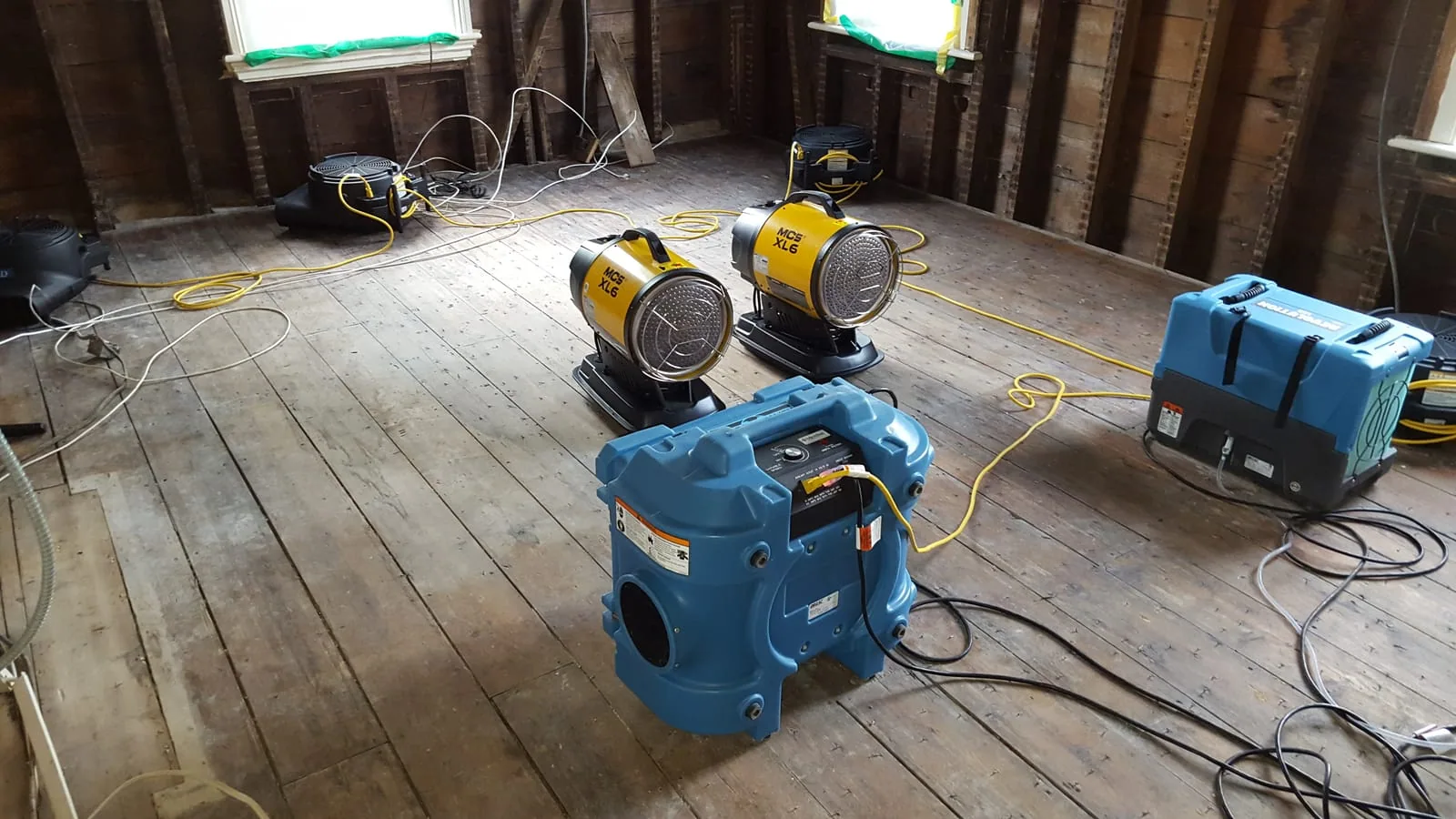
Low-Grain Refrigerant (LGR) units are the workhorse of water damage restoration:
- Remove 130-150+ pints/day at AHAM conditions
- Continue performing at 85% RH (where residential units fail)
- Drive indoor grain depression to 40-50 grains below ambient
- Include internal pumps for continuous drainage to 100+ feet
- Typically 60-80 lbs and hard-used daily
Modern restoration jobs use multiple LGR units in parallel, sized to the cubic footage and water load.
Desiccant Dehumidifiers — Cold-Weather Workhorse
Below 40°F, refrigerant-based LGR units lose efficiency. Desiccant units use silica gel or molecular sieve to chemically pull moisture from the air — work down to 0°F and below.
- Higher capacity than LGR in extreme conditions
- Work at lower humidity levels (grain depression > 100)
- Larger footprint, diesel or natural gas options available
- Standard for winter basement restoration in CT/NY
Air Movers — The Other Half of the Equation
Dehumidifiers remove vapor from air. Air movers evaporate liquid water INTO air. Without air movers, water stays liquid in carpet, drywall, and framing — dehumidifier can't help. Without dehumidifiers, air movers just redistribute moisture.
Proper drying uses both: one air mover per 10-16 linear feet of wet wall, paired with LGR dehumidification sized to cubic footage.
Psychrometric Calculations
Proper restoration uses daily psychrometric measurements:
- Temperature (indoor and outdoor)
- Relative humidity
- Grains per pound (GPP) — absolute moisture content
- Dew point
These readings tell us equipment is actually removing moisture, when to add more equipment, and when drying is complete. Without measurements, drying is guessing — and guessing leads to hidden pockets of moisture that trigger mold growth.
When Is Drying Complete?
IICRC S500 defines complete drying as materials at pre-loss moisture content or at equilibrium with the surrounding dry environment. Typical targets:
- Drywall: < 1% moisture content (MC)
- Wood framing: < 15% MC
- Concrete: Typically 4-6% MC
- Subfloor: < 15% MC
We verify with penetrating and non-penetrating moisture meters at multiple points, then declare dryness when all points hit target for 2 consecutive days.
When your Greenwich, Stamford, or Westchester property has water damage, our crews arrive with truck-loaded LGR and desiccant dehumidifiers, industrial air movers, thermal imaging cameras, and moisture meters. Scientific, measurable drying that insurance trusts. Call 911 Storm for 60-minute dispatch.
Frequently Asked Questions
How many dehumidifiers does a typical job need?+
Depends on cubic footage, water load, and materials. A medium flooded basement might need 2-4 LGRs. Whole-house water events can use 8-15 units simultaneously.
Is running my AC or home dehumidifier enough?+
Rarely. AC systems don't have the grain depression needed for structural drying. Home dehumidifiers lack capacity and proper drainage. Use these for humidity control — not water damage restoration.
How long do restoration-grade units run?+
Typically 3-7 days for standard water damage, longer for saturated materials. Running continuously for the entire drying period is standard — they're built for it.
What does the equipment cost me?+
In insurance-covered jobs, the equipment rental is part of the Xactimate scope — you pay only your deductible. Out-of-pocket drying costs $100-$300 per day for equipment plus labor.
Related Services
Raf Volkov
Raf has personally supervised more than 100 restoration projects across Fairfield County, CT and Westchester County, NY since 2003. He holds IICRC Water Damage Restoration (2016), IICRC Fire & Smoke Restoration (2016), Goldmorr AIM Mycotoxin Remediation, EZ Breathe Installer, and Stego Vapor Barrier / ASTM E1643 certifications — attending manufacturer trainings every year. Every protocol on this site is built on standards he's trained and re-trained in.