
What S500 actually covers
S500 is the Standard and Reference Guide for Professional Water Damage Restoration. It's published by the IICRC (Institute of Inspection, Cleaning and Restoration Certification) and updated every few years. The current version (S500-2021) is the document your insurance adjuster opens when they read a contractor's water damage scope.
It covers four big areas: (1) water classification — categorizing the source from clean to biohazard, (2) materials science — how different building materials respond to moisture, (3) the restoration process — extraction, drying, dehumidification, and verification, and (4) safety and documentation — what records the contractor must keep and what PPE the crew must wear.
The key insight for homeowners: S500 is detailed enough that two IICRC-certified contractors should reach roughly the same scope for the same loss. If you get wildly different scopes from two "certified" companies, one of them is probably not actually working to the standard.
The three water categories — and why they drive cost
S500 classifies water into three categories based on source and contamination. The category determines what materials can be saved, what PPE the crew wears, and how much demolition is required.
Category 1 — Clean water. Source is sanitary at the time of the loss: supply line break, rainwater intrusion, refrigerator overflow, melting ice. Most materials can be dried in place. Lowest scope cost. But if Cat 1 water sits more than 48 hours, it can deteriorate to Cat 2 due to ambient microbial growth.
Category 2 — Gray water. Source contains significant contamination: washing machine discharge, dishwasher overflow, sump pump discharge, broken aquariums. Requires more aggressive cleaning, antimicrobial application, and often demolition of porous absorbent materials (carpet pad, particleboard).
Category 3 — Black water. Grossly contaminated: sewage backup, toilet overflow, rising surface water from rivers or storm drains. Requires full PPE (Tyvek, respirators), demolition of all porous materials the water touched, antimicrobial treatment of all remaining surfaces, and biohazard disposal. Highest scope cost — sometimes 3-5× a Cat 1 loss of the same square footage.
An honest contractor will tell you the category at the inspection and document why. If they can't articulate it, they're not following S500.
Drying targets — the numbers your contractor should be hitting
S500 defines drying targets in terms of moisture content (MC) of the affected materials. Different materials have different targets:
Framing lumber (pine, fir): Target MC ≤ 16%. Pin meters read directly through the wood.
Drywall: Target relative moisture ≤ baseline (compared to a dry reference wall in an unaffected area of the same home).
Hardwood flooring: Target MC within 2% of acclimatized baseline (typically 7-9% in Fairfield County). Higher and you risk permanent cupping or warping.
Concrete (basement slabs, foundations): Target relative humidity (via RH probe at depth) ≤ 75% if planning to install non-permeable flooring (vinyl, epoxy), ≤ 80% for breathable finishes.
Your contractor should be running a moisture log: every test point, every day, recorded with calibrated instruments. If they're not, they have no way to prove the structure is actually dry — which means they have no way to prove there won't be mold in the walls three months later.
Equipment requirements
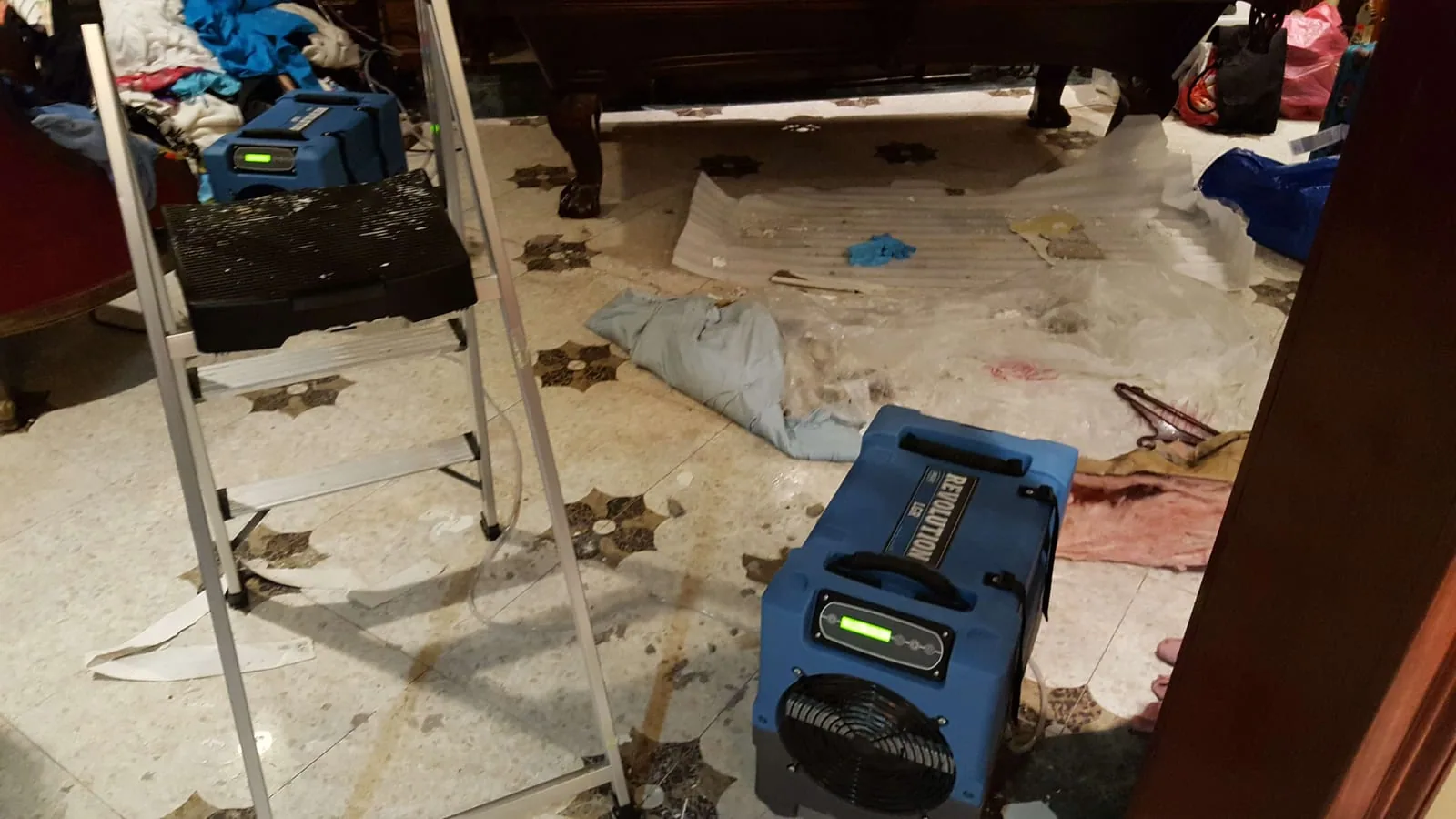
S500 doesn't mandate specific brands, but it does mandate categories of equipment proportional to the affected square footage and water class. For a typical residential water loss you should see:
Truck-mounted or portable extractors sized for the standing water volume. Wet-vacuums alone are not adequate for anything more than a small leak.
LGR (Low Grain Refrigerant) dehumidifiers, which can remove moisture from air down to lower grains per pound than conventional refrigerants — critical for drying enclosed spaces below 60°F.
Axial or centrifugal air movers sized to move air across all wet surfaces. Rule of thumb: roughly 1 air mover per 50-70 sq ft of wet surface, more for cold or enclosed spaces.
Moisture meters — both pin (penetrating) and pinless (capacitance) for different material types.
Thermal imaging cameras for non-invasive moisture mapping of hidden wet areas. Not strictly required by S500 but considered current best practice.
HEPA air scrubbers when working on Cat 2 / Cat 3 losses or when there's any mold concern.
The drying timeline — what realistic looks like
A common homeowner question: how long should drying take? S500 doesn't mandate a fixed timeline — drying is complete when the moisture targets are met, full stop. But here are realistic ranges for a typical residential loss:
Cat 1, single room, small area: 3-5 days.
Cat 1, multi-room or basement-scale: 5-7 days.
Cat 2, single room: 5-7 days (extra time for cleaning + antimicrobial).
Cat 2, multi-room: 7-10 days.
Cat 3, any size: 10-21 days minimum (demolition + cleaning + drying + verification).
If a contractor promises drying in 2 days on a multi-room loss, ask how they're going to verify the framing inside the walls is dry. The answer should involve specific test points and specific MC targets — not just "we'll check it."