
Air Quality Testing
Professional air sampling to detect mold spores and contaminants invisible to the eye.
Our Air Quality Testing Process
Emergency Call
Call our 24/7 line — crew dispatched immediately.
60-Min Arrival
We arrive, assess, and brief you on the plan.
Mitigation
Stop damage from spreading — fast.
Full Restoration
Certified restoration to pre-loss condition.
Air Quality Testing in Fairfield County, CT & Westchester County, NY
Air quality testing is the diagnostic instrument behind every mold investigation, post-remediation verification, and chronic-symptom indoor environment assessment we perform. Visible mold growth is only part of the picture — airborne spore concentrations, particulate levels, and chemical contamination determine the actual exposure burden on occupants. Without quantitative air sampling, mold investigations are guesswork and remediation verification is unverifiable.
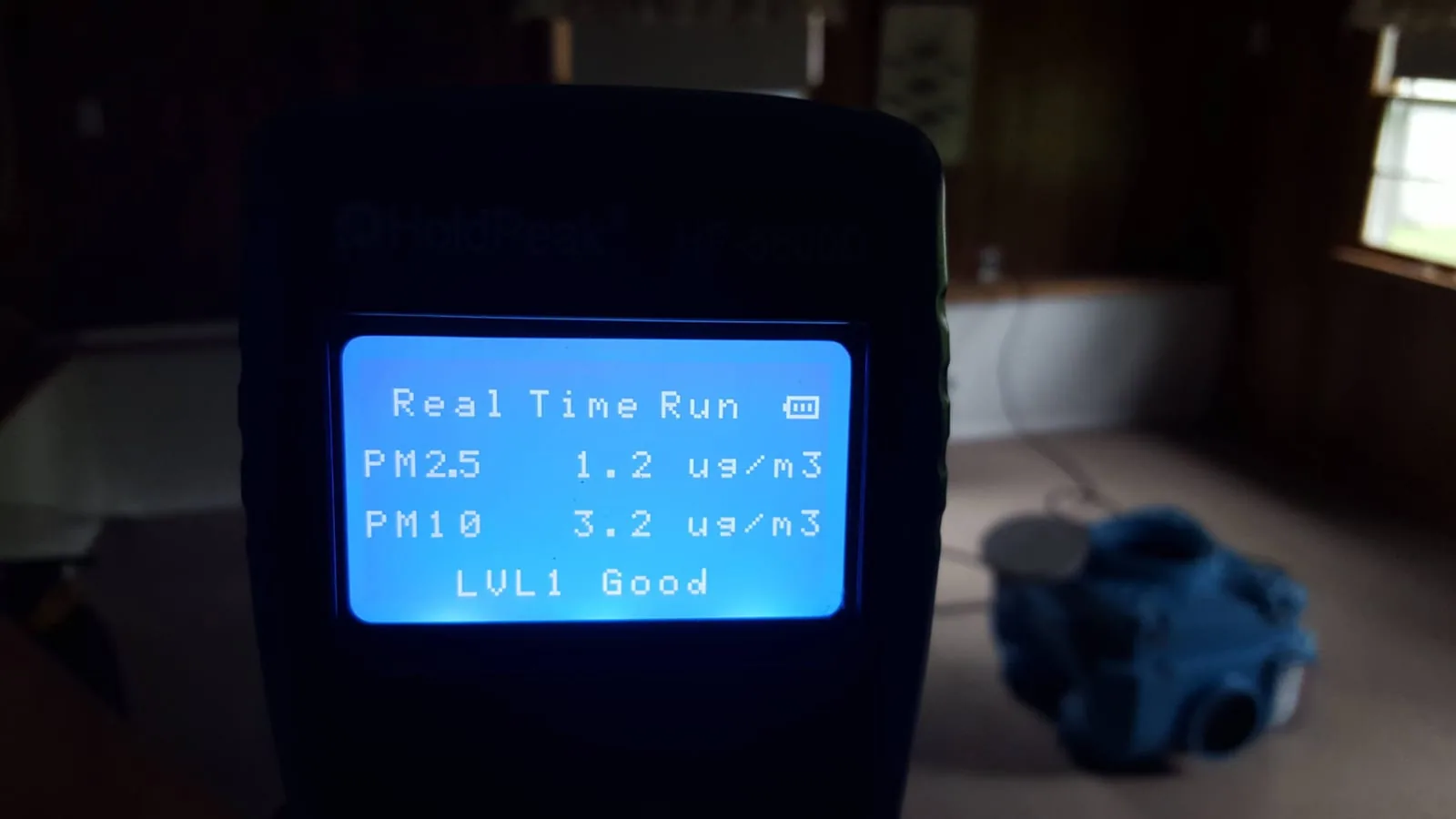
911 Storm provides indoor air quality testing across Fairfield County, CT and Westchester County, NY using calibrated sampling equipment and accredited third-party laboratory analysis. We perform air sampling for mold spore counts, surface sampling for species identification, real-time particulate monitoring (PM2.5 / PM10), and chain-of-custody sample handling that produces lab results admissible for insurance and litigation purposes.
What air quality testing actually measures
Spore-trap air sampling collects airborne mold spores using a calibrated spore-trap cassette connected to a constant-flow pump for a defined sampling duration (typically 5-10 minutes per sample). Indoor samples are compared against outdoor baseline samples taken on the same day in the same location — indoor spore counts should be at or below outdoor counts for a healthy environment. Indoor counts significantly elevated above outdoor baseline indicate active mold contamination requiring source identification.
Particulate monitoring (PM2.5 and PM10) measures airborne particle concentration in real time — useful during cleanup work to verify containment is working (no particulate migration out of the work zone) and at post-remediation clearance to verify air quality has returned to safe baseline. Chemical air sampling (VOCs, formaldehyde, specific compounds) is sometimes added for chronic-symptom investigations or post-fire smoke residue verification.
When air quality testing is the right tool
Pre-remediation investigation when visible mold is limited but musty smell or occupant symptoms suggest broader contamination. Post-remediation verification (PRV) before dismantling containment — visual + moisture + spore counts together provide objective proof remediation succeeded. Chronic-symptom investigations where occupants experience respiratory symptoms, headaches, or other indoor-environment-related health issues without obvious mold source. Real-estate due diligence for buyers concerned about pre-purchase indoor air quality.
We do NOT recommend air sampling without a clear question to answer. "Routine" air sampling without specific suspicion produces results that are difficult to interpret meaningfully. Each test should answer a specific question (e.g., "is the remediation work complete?" or "is the contamination from the visible spotting in this room broader than visible?").
Lab analysis and result interpretation
Samples are sent to accredited third-party laboratories (typically EMLAP-accredited for mold analysis) with chain-of-custody documentation. Standard turnaround is 48-72 hours; rush 24-hour turnaround is available for time-sensitive scenarios at premium pricing. Lab results identify specific mold species (genus and species where possible) and spore counts per cubic meter of sampled air.
We walk you through result interpretation: which findings are normal background, which indicate elevated contamination, which suggest active growth in the space vs general background. The lab report itself is the objective document; our interpretation puts the findings in context for next-step decisions (further investigation, remediation scope, clearance approval).
Related Mold Removal Services
Air Quality Testing Near You
Covered loss? We bill your insurance carrier directly — and our CT insurance claim guide walks the whole process. Estimate your scope with the cost calculator.
How Long Does Air Quality Testing Take?
Every job is different, but here's a realistic timeline for most air quality testing projects.
Emergency Call
0 min24/7 dispatch, same-day assessment scheduling.
Assessment + Testing
Day 1Visual, surface samples, air samples sent to lab.
Containment Setup
Day 2-3Poly sheeting, HEPA air scrubbers, negative pressure.
Active Remediation
Day 3-10Controlled demo, antimicrobial treatment, HEPA cleaning.
Clearance Testing + Rebuild
Day 10-14+Independent air test verifies clearance, then rebuild.
Timelines vary with scope, insurance adjuster response, and hidden damage discovered during work. Your detailed timeline is given after the on-site assessment.
Common Questions
Air Quality Testing FAQ
When should I get air quality testing for mold?
Pre-remediation investigation when visible mold is limited but you suspect broader contamination. Post-remediation verification before containment dismantles. Chronic occupant symptoms (respiratory, headaches, allergies) without obvious cause. Real estate purchase due diligence in homes with finished basements or moisture history. Avoid routine "just to check" testing without specific suspicion — results without context are hard to interpret.
How does air quality testing for mold work?
Calibrated spore-trap cassette + constant-flow pump runs for 5-10 minutes collecting airborne particles. Indoor samples compared against outdoor baseline sample taken the same day. Samples sent to accredited third-party lab with chain-of-custody documentation. Results identify mold species and spore counts per cubic meter. Standard turnaround 48-72 hours, rush 24-hour available.
What is a normal indoor mold spore count?
Healthy indoor environments typically have spore counts at or below outdoor baseline (taken on the same day in the same location). Outdoor baseline varies by season, weather, and geography — typically 200-2,000 spores/m³ in Fairfield/Westchester during summer, lower in winter. Indoor counts significantly above outdoor baseline (3-5× or more) indicate active indoor mold source requiring investigation.
Will air testing tell me if my house is making me sick?
Air quality testing identifies presence and concentration of specific mold species and indicates whether indoor levels are elevated compared to outdoor baseline. Translating that into individual health attribution requires medical evaluation — not all elevated mold exposure causes symptoms, and not all symptoms are mold-attributable. Combination of air testing + medical evaluation by an indoor-environment-aware physician is the right diagnostic path for chronic symptoms.
What does air quality testing cost?
Single-room investigation (1 indoor sample + 1 outdoor baseline + lab analysis): $400-$700. Multi-room investigation: $700-$1,500. Post-remediation verification (multiple samples + comprehensive lab): $800-$1,800. Real-time particulate monitoring during work (no lab fees): $250-$500. Cost depends on number of samples, lab turnaround, and inclusion of species identification. Free on-site assessment to scope testing requirements before sample collection.
Damage Doesn't Wait — Neither Do We
60-minute response. Free estimate. We handle your insurance claim.
IICRC Certified • Licensed & Insured • All Major Insurance Carriers